1.What is the definition of psychology?
Psychology is the scientific and systematic study of human behavior and cognitive processes.
2.Why is psychology considered a bio science?
Psychology is a bio science as it examines the relationship between mind and body, neural mechanisms, and the influence of heredity on behavior. To understand the influence of heredity on behavior we must know how genes and heredity works as well as to understand the mind and body we must understand its functions. This can only be done through the study of biology.
3.Why is psychology considered a pure science?
Psychology is considered as a pure/ natural science as it follows a scientific method just like biology or chemistry. After studying patterns in human behavior, psychologists develop a specific testable prediction/theory on why that behavior happens, or even conduct scenarios to see if it leads to a change in behavior.
4.Why is psychology considered a social science?
Psychology is considered a social science as it studies the behavior of human beings in their social cultural contexts. It focuses on the individuals and communities in relation to their socio-cultural and physical environment. Humans are not only influenced by their socio-cultural context, but they also create them.
5.What is behavior?
behavior can be defined as the actions or reactions of a person in response to external or internal stimulus situation. for example, perceiving (cognitive), walking (motor or conative), eating (overt), thinking (covert), feeling happy (emotional or affective).
6.what is a stimulus?
Stimulus is the influence that the environment exercises on an organism which causes it to take action. For example, seeing a sharp object moving close to our eyes and our eyes closing. Here the sharp object moving close to our eyes is the stimulus.
7.What is a response?
Response is the activity so aroused due to a particular stimulus. For example, seeing a sharp object moving close to our eyes and our eyes closing. Here the closing of our eyes is the response.
8.What do mean by eclectic approach of Psychology?
Eclectic means deriving ideas or theories from a broad and diverse range of sources. So, the eclectic approach of modern Psychology is that it tries to explain human behavior using more than one perspective and develops applications based on more than one approach. For example, therapists use an eclectic approach when they work with their clients to create a treatment plan that includes different techniques and methods for the betterment of their clients. Another example, majority of psychologists now a days focus on different areas and perspectives of the different schools of thoughts to draw on different ideas. This eclectic approach has led to new ideas and theories.
9.Explain Structuralism.
It is the first school of thought. Its main feature (concept, theme, principle) is that it was focused on breaking down mental processes into basic components which is called Reductionism. Structuralists used a method called introspection to understand the basic units. Introspection is a highly practiced form of self-examination. In which people try to look inside themselves and describe what is going on. The founder of Structuralism and the first psychology lab is Wilhelm Wundt. He used Introspection to train his subjects in which he asked them to objectively report what they experienced in connection to a stimulus disregarding any previous connections with that stimulus. Edward Titchener was a follower of Wilhelm Wundt. He explained conscious experiences by breaking them into 3 elements which are physical sensations, feelings and images. For example, when a person views a flower, the physical sensations are what that object was to that person, the feelings of like or dislike of that object and any images associated with that flower such as past experiences or previous imaginations.
Its criticism is that the experimental methods like introspection were too subjective making them non reliable. They were also too focused on internal behaviour which cannot be observed or measured.
Its strengths are that it is the first major school of thought and that it influenced experimental psychology.
10.Explain Functionalism?
Functionalism formed as a reaction to structuralism. Its main theme is that it was focused on the function of the consciousness and how it adapts to the environment. Major psychologists William James, John Dewey and James Angell. James Angell was influenced by John Dewey. Functionalism is also influenced by the evolutionary theory of Charles Darwin. Charles Darwin stated that only the fittest will survive.
Its criticism is that it has a strict focus on the consciousness which cannot be experimented on. It is extremely objective in its approach, and it also ignores the subjective tendencies of human behavior.
Its strengths are that it influenced the emergence of other theories ad it is applied in the educational system in adopting various schools of teaching.
11.Explain Behaviorism.
Its main theme is that is emphasis the role of environment in guiding behavior. It is only concerned with observable stimulus and response behaviors. It states that all behaviors are learned through interactions with the environment. Main psychologists are John Watson and Carl Hull. John Watson along with B.F. skinner helped to develop behaviorism. Watson focused on the observable behavior of individuals such as changes in heart rate or blood pressure, etc. He based his theories on finding of Ivan Pavlov’s Classical Conditioning theory. Watson did the experiment of Little Albert and white rats. Carls works are known as drive theory or systematic behavior theory. According to him organisms act in ways that support the best possible requirement of survival.
Its criticism is that it completely ignores the genetics of a person and failed to give a clear view of the scope, aim and subject matter of psychology.
Its strengths are that it helped in therapies, and it helped to define behavior theory (observable behavior)
12.Explain Gestalt psychology.
It started as an opposition to structuralism and functionalism. Its main theme is that everything is perceived as a whole and not a mere collection of its singular elements. The German word Gestalt means form or configuration or an organized whole. Researchers used method called wholeism. Which means viewing everything as a whole. Its psychologists are Max Wertheimer, Wolfgang Kohler and Kurt Koffka. Max strongly believed in wholeism and was interested in perception and productive thinking. Wolfgang believed that Gestalt theory was completely opposite of structuralism. He was more interested in covert behavior that internal unobservable behavior rather than overt that is observable external behavior.
Its criticism is that it does not explain the function of the brain, it neglects the scientific approach, and it differs from person to person.
Its strengths are that it is subjective, and it introduced human perception and motivation.
13.Explain Psychoanalysis.
It is the most distinct and influential school of thought. Its main theme is that it emphasized the role of unconscious forces in shaping behavior. It was founded by Sigmund Freud. Freud believe that people could be cured by making their unconscious conscious by appropriate catharsis (venting out). He also believed that childhood experiences had an important role on adulthood personality. He believed that dreams are a gateway to unconsciousness. Slip of tongue also called Freudian slip was also a way to unconsciousness. He believed that much of our behaviour is governed by hidden motives and unconscious desires. According to him many unconscious desires and conflicts are sexual.
Its criticism is that it has too much emphasis on childhood, sexual approach and that development of personality is lifelong not only during the childhood.
Its strengths are that it offered in depth perspective of defence mechanism and repressed thoughts and it also focused on development considerations from infancy to adulthood.
14.Timeline of the schools of thought.
Structuralism – 1890- 1920
Functionalism – 1890s
Psychoanalysis- 1856-1939
Gestalt- began in 1920
Behaviorism – 1920-1950
15.Why is Psychology important?
Psychology is of great importance because it focuses on understanding, explaining and predicting human behavior, emotions and mental processes. It is used to better understand and help people with psychological disorders and mental illnesses.
16.What is mental retardation?
Mental retardation is also known as intellectual disability.
What is it?
It is a heredity disease which refers to the substantial limitations in the functioning of the brain. It usually starts before the age of 18 and is characterized by significantly sub average intellectual functioning. There are also limitations in two or more applicable adaptive skill areas like communication, self-care, social skills, health and safety, self-direction and work. There are four levels of ID which are mild, moderate, severe and profound.
What are the signs of it in children?
There are many different signs of it in children. These signs may appear during infancy or they might not be noticeable until the child reaches school age. These signs are:
• Rolling over, sitting up, crawling, or walking late
• Talking late or having trouble with talking
• Slow to master things like potty training, dressing, and feeding himself or herself
• Difficulty remembering things
• Inability to connect actions with consequences
• Behavior problems such as explosive tantrums
• Difficulty with problem-solving or logical thinking
In children with severe or profound ID might also have health problems such as seizures, mood disorders (anxiety, autism, etc.), motor skills impairment, vision problems or hearing problems.
What causes ID?
Any interference with the normal brain development may lead to ID. Only about 1/3rd of the time can the causes be identified. For example:
• Genetic conditions – These include things like Down syndrome and fragile X syndrome.
• Problems during pregnancy – Things that can interfere with fetal brain development include
alcohol or drug use, malnutrition, certain infections, or preeclampsia.
• Problems during childbirth – Intellectual disability may result if a baby is deprived of
oxygen during childbirth or born extremely premature.
• Illness or injury – Infections like meningitis, whooping cough, or the measles can lead to intellectual disability. Severe head injury, near-drowning, extreme malnutrition, infections in the brain, exposure to toxic substances such as lead, and severe neglect or abuse can also cause it.
• None of the above – About 2/3rd of the times the cause is unknown.
How is it diagnosed?
Intellectual disability may be suspected for many different reasons. If a baby has physical abnormalities that suggest a genetic or metabolic disorder, a variety of tests may be done to confirm the diagnosis. These include blood tests, urine tests, imaging tests to look for structural problems in the brain, or electroencephalogram (EEG) to look for evidence of seizures. In children, with development delays, the doctor will perform tests to rule out other problems, including hearing problems and certain neurological disorders. If no other cause can be fund for the delays, the child will be referred for formal testing. Three things factor the diagnosis of ID: interviews with parents, observation of the child, and testing of intelligence and adaptive behaviors. A child is consider intellectually disabled if he or she has deficits in both IQ and adaptive behaviors. If only one is present then the child is not considered intellectually disabled. After the diagnosis of ID, a team of professionals will assess the child’s particular strengths and weakness. This helps them determine how much and what kind of support the child will need to succeed at home, in school and in the community.
The main goal of the treatments is to help the child reach his/her full potential in education, social skills, life skills.
The treatment may include behavior therapy, occupational therapy, counseling and medication in some cases).
17.What is Huntington’s disease?
It is caused due to inherited faulty genes that results in neurological conditions. The symptoms are usually seen between the age 30 to 50 years but may also been seen before or after the said age. It has no cure and tends to be fatal. Some of the symptoms are changes in personality and mood, trouble with remembering things, loss of movement control, problem with speaking and swallowing.
18.What are twin and adoptive studies? Twin and adoption studies are used to show how much of a behavior or trait is due to genetics or due to the environment. Identical twins share 100% of their genes, whereas non-identical fraternal twins share only half of their genes- 50%. Therefore, they are included in analysis to help identify the impact of genes on a particular topic. Adopted children’s similarity to their biological parents reflects genetic similarity and eliminates environmental factors. Adopted children with adopted parent similarity reflects environmental similarity and eliminates genetic similarity. Therefore, Adoptive children are included in analysis to help separate the effects of growing up in shared environments.
19.What is the difference between nurture and nature?
Nature refers to all the genes and hereditary factors that influence our physical appearance and personality. Whereas Nurture refers to all the environmental influences that impact who we are, our childhood experiences, how we were raised our social relationships and our surrounding culture.
Nature vs Nurture.
Nature vs Nurture is one of the oldest issues of psychology. The debate centers the greater impact of hereditary or of environment on human behavior. Plato and Descartes suggest that things are inborn. Nativists took the position that all behaviors are due to inheritance. An example of Nativist theory is Chomsky’s concept of language acquisition device (LAD). According to this theory all children were born with instinctive mental capacity that allows them to learn and produce language. John Locke believed in tabula Rasa which suggest that the mind is a blank slate. Empiricists took the position that all behaviors are due to learning. An example of Empiricist theory is Albert Bandura’s social learning theory. According to this theory people learn by observing the behavior of others. In his famous Bobo Doll experiment, Bandura demonstrated that children could learn aggressive behaviors simply by observing another person act aggressively.
Two studies of nature.
Schizophrenia- Gottesman- Shields’s Study in 1967. In order to determine whether a serious mental, Schizophrenia has a genetic link, Gottesman and Shield conducted twin and adoption studies. How often both twins were diagnosed with schizophrenia was compared for monozygotic identical twins and dizygotic non-identical twins. In adoption studies, the genetics and environment of biological parents and siblings were compared to adopted parents and siblings. In twin studies, the concordance rate for schizophrenia in MZ twins was 58% whereas in DZ twins it was 12%. In adoption studies, there was an increase in incidence of schizophrenia where the biological parents had schizophrenia. A normal child fostered to a Schizophrenia parent the same as normal parents adopting a Schizophrenic child showed less evidence of schizophrenia.
Plomin study in 1988– Plomin found that 68% of IQ was due to genetic influences when identical or non-identical twins both living together or apart were studied. When identical twins were raised apart, they showed a 74% of IQ similarity. Therefore, showing that genetic influence is greater than environmental influence.
Two studies of nurture.
Little albert– was an experiment done by Watson and Raynor in 1920. A case study on one child ‘Little Albert’, under controlled laboratory conditions was carried out to see if it is possible to induce a fear of a previously unfeared object through classical conditioning. Before the experiment little albert showed no fear response to any objects including a white rat. During the first few sessions Albert was presented a rat. Each time her reached it a steel bar was hit. After a few sessions he started reacting to the rat itself without the steel bar sound. By session 3 the fear was developed for all furry objects like fur coat or Santa hat. Later psychologists saw that time had not removed the fear for Albert.
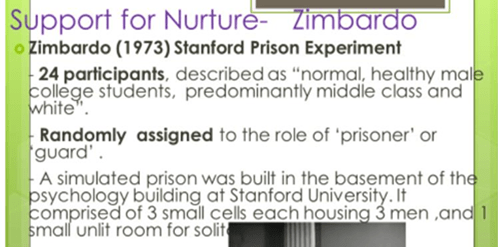
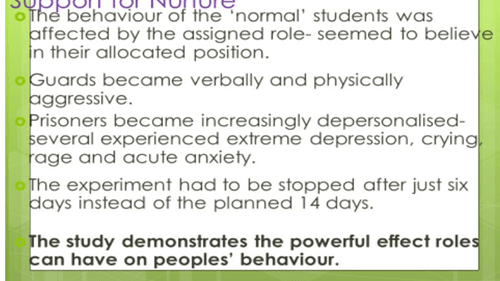
Zimbardo –

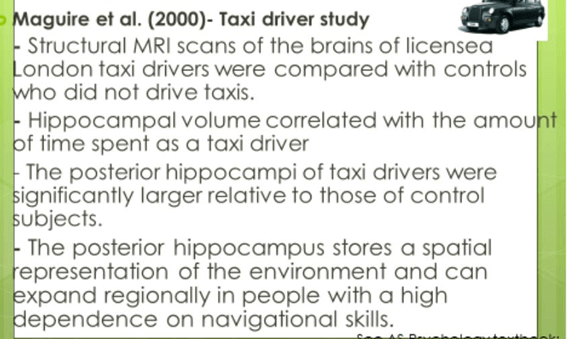
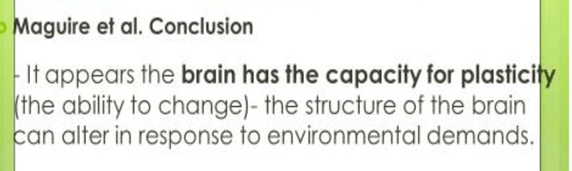
20.How do nature and nurture interact? What researchers do know is that the interaction between heredity and environment is often the most important factor of all. Kevin Davies of PBS’s Nova described one fascinating example of this phenomenon.
Perfect pitch is the ability to detect the pitch of a musical tone without any reference. Researchers have found that this ability tends to run in families and believe that it might be tied to a single gene. However, they’ve also discovered that possessing the gene alone is not enough to develop this ability. Instead, musical training during early childhood is necessary to allow this inherited ability to manifest itself. Therefore, both nature and nurture play an important role in the behavior of an individual
A study to prove their interaction: