1.What are emotions?
Emotions are a complex state of feeling that results in physiological and psychological changes, which in turn influence thought and behavior.
Paul Ekman is a psychologist who did work around emotions and physical expressions.
2.Explain the primary emotions?
The five main primary emotions are anger, fear, affection, sorrow and joy.
Anger is an emotion that is a strong negative feeling of dissatisfaction and resentment due to some perceived mistakes, frustration or personal damage caused by others.
Fear is a negative emotion which people avoid to experience and is stimulated by perceived danger or threat.
Sorrow is a negative emotion of deep distress caused due to disappointment or misfortune.
Affection is a positive emotion of liking, endearment and warmth
Joy is a positive emotion indicating feelings of pleasure or satisfaction.
3.Explain the James-Lange theory of emotion? What, who, idea, flow, ex, dis
The James-Lange theory states that human beings, as a response to stimulus, the autonomic nervous system creates physiological events (like muscular tension, a rise in heart rate, perspiration, and dryness of the mouth) which give rise to emotions (like fear, joy), rather than being their cause.
William James and Carl Lange arrived at this theory independently.
They both stated that emotions are consequences of physiological reactions to external events. James focused more on emotion as a consequence of a physiological change whereas Lange focused more on emotion as a demonstration of a physiological change.
An example for this theory is that when a threatening bear is approaching (stimulus) a person, the heart starts pounding, he/she starts to tremble and sweat (physiological arousal) and then finally the person feels fear.
Its criticism is that it has been observed in many experiments that people feel emotions without a physiological arousal. Psychological reactions associated with some emotions are same.

4.Explain the Cannon-Bard theory of emotion? What, who, idea, flow, ex, dis
The Cannon-Bard theory states that we feel emotions and experience physiological reactions simultaneously. This theory was proposed in refutation to the James-Lange theory.
Walter Cannon proposed this theory and it was later revised by Phillip Bard.
This theory suggested that emotions can be felt even when the body does not reveal a physiological reaction.
An example for this theory is that when you are walking alone in the dark and hear some trailing footsteps and see a shadowy figure following you. You experience emotion of fear and heart pounding, sweating, running away at the same time. A criticism of this theory is that the experiments were carried out on animals and therefore, cannot be generalizable to humans. Theory is very subjective in nature as a stimulus can be perceive differently by people in different conditions.
5.Explain the Schachter-Singer theory of emotion? What, who, idea, flow, ex, dis
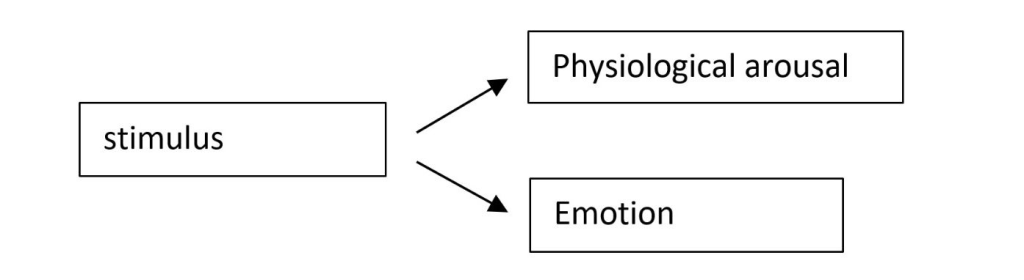
The Schachter-Singer theory is also called the two-factor theory as it focuses on the interaction between physical arousal and our cognitive interpretation of the stimulus that leads to the arousal.
Stanley Schachter and Jerome Singer proposed this theory.
They both did an experiment for this theory and found that in the event that the person has no explanation for an arousal state he or she will label the arousal in terms of available cognitions. Whereas in the event that the person has an explanation for an arousal, alternative cognitive labeling will be unlikely.
For example, if a physiologically aroused person is near an angry mob, he/she might label that arousal as anger whereas if the same person is in a concert, he/she might label the arousal as excitement.
A criticism of this theory is that the environmental reasons for emotions were over emphasized. When the same experiment was done again researchers found different results.

6.Explain the experiment that Schachter-Singer performed.
They both did an experiment for the Schachter-Singer theory of emotion. People were divided into three groups and sent into three different rooms and they were all given an adrenaline injection. One group was told what injection they were given, the other group was misled and told that this injection will give them headache and the third group was not told anything. A confederate of the experimenter was present in the room and behaved either playful or angry. The group that knew what the injection was did not manifest an emotion mirroring the confederate whereas the group that had no idea behaved similarly to the confederate. They found that in the event that the person has no explanation for an arousal state he or she will label the arousal in terms of available cognitions. Whereas in the event that the person has an explanation for an arousal alternative cognitive labeling will be unlikely.
7.What is motivation?
Motivation is a need or desire that energizes behavior and directs it towards a goal.
8.Name the three components of motivation.
The major three components of motivation are activation, persistence and intensity.
Activation is the initial urge and decision to initiate a behaviour. Persistence is the spontaneous effort to pursue a goal and also overcome the obstacles. Intensity is the degree of energy, effort in pursuing a goal.
9.What are needs and drives?
Need or desire is a psychological feature that arouses an organism to action toward a goal, giving purpose and direction to behavior. The feeling of some deficiency that creates a state of uneasiness eventually produces certain arousal in terms of energy or force known as a drive.
Feeling of dissatisfaction or deficiency
Need or desire
State of uneasiness in mind
Drive or force
Need satisfaction and reduced drive
Specific behavior

10.What are instincts?
Instincts are automatic, involuntary and unlearned patterns of behaviour triggered by the presence of a particular stimuli. Instincts are found to be similar among all members of a certain species. For example, motherhood with all its psychological and physiological characteristics is instinctual and is very common across all species. Instincts are complex and are not the same as reflex actions. They are an inborn nature that triggers a set of corresponding behaviour that are called the instinctual behaviour. For example, birds build nest without any training at the right time and protect their young ones. William James proposed that behaviours of human beings are determined largely by instincts. Sigmund Freud proposed that instincts are of two main types. Eros, the life instinct that propels one to engage in self-preservatory actions like reproduction and the Thanatos, the death instinct that instigates one to engage in self-destructive actions like aggression.
11.Explain the different kinds of motivation.
There are four kinds of motivation that are physiological, psychological, intrinsic and extrinsic.
- Physiological: hunger thirst, physical protection, movement, avoidance of pain
- Psychological: Power, achievement, need for acceptance, need for appreciation, self- motivation
- Intrinsic: it is a motivation that comes from within the individual and is driven by an interest or enjoyment in the task itself. Ex, writing music for self-pleasure.
- Extrinsic: It is a motivation that comes from outside the individual such as reward and punishment. Ex, writing music to earn money.
12.Explain the Pull and Push theories of motivation.
Push motivation or drive motivation states that individual behaviors are pushed by internal drives towards a goal. It is a behavior that an individual force him/herself to complete in order to satisfy a need or to achieve a goal. For example, a student who does not like maths but has to appear for an engineering entrance exam. He/she will be motivated to study maths in order to crack the exam.
Pull motivation or incentive motivation is a behavior that an individual feel drawn towards and takes action for an end result. For example, a fan who is drawn to the concert of their favorite band.
13.Explain the Optimum arousal theory of motivation.
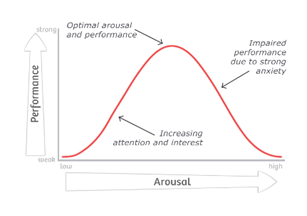
It states that people are driven to perform actions in order to maintain an optimum level of physiological arousal. Every person has a unique, personalized optimum level. If it drops then people try to elevate it back to optimum. If it exceeds then they try to bring it back to an optimum. For example, if a person’s level drops to low then he/she might like to party to bring it back, or if his/her level becomes to elevated then he/she might do a relaxing activity like walking. Arousal refers to the state of alertness and level of activation which is produced from internal or external stimulus.
Yerkes- Dodson Law– states that an organism’s performance can be improved if that organism is aroused in some manner. However, if the level of arousal increases/decreases too much, performance decreases. It was developed by Robert M. Yerkes and John D. Dodson. It is represented by an inverted U-function. Example, if for an exam a person is too stressed that is his/her level of arousal is high or if a person doesn’t care about the exam that is his/her level of arousal is low then in both cases the performance will decrease.
15.Explain the Expectancy theory of motivation.
It was proposed by Victor Vroom. It states that motivation is governed by the expectation of outcomes governed by rewards or incentives. According to this theory the effort leads to better performance which leads to gaining the expected results. It consists of three key elements that are valence, instrumentality and expectancy. Valence is the value that people place on the expected outcome. Personal benefit, higher valence. For example, studying hard, getting good marks. Instrumentality refers to whether people believe that they have a role to play in the outcome. If the event is random and outside the control of the individual then the individual is less motivated and vice versa. For example, If an individual is the topper of the grade which will get him/her a reward then he/she is more motivated. Expectancy is the belief that one has the capabilities of producing the outcome. If a person feels he/she lack the skills then he/she will be less motivated. For example, a maths topper writing a maths exam.
15.Explain the Maslow’s need hierarchy theory of needs.
The need hierarchy was proposed by Abraham Maslow. Maslow’s hierarchy of needs is a motivational theory in psychology comprising a five-tier model of human needs, often depicted as hierarchical levels within a pyramid. From the bottom of the hierarchy upwards, the needs are: physiological, safety, love and belonging, esteem and self-actualization.
- Physiological needs – these are biological requirements for human survival, e.g., air, food, drink, shelter, clothing, warmth, sex, sleep.
- Safety needs – protection from elements, security, order, law, stability, freedom from fear.
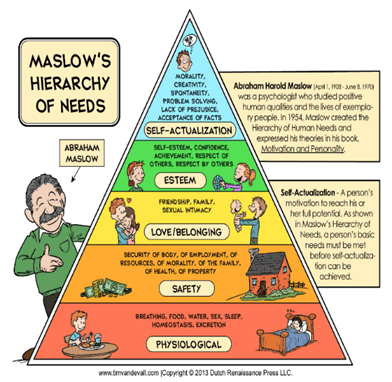
- Love and belongingness needs – friendship, intimacy, trust, and acceptance, receiving and giving affection and love.
- Esteem needs – esteem for oneself (dignity, achievement, mastery, independence) and the desire for reputation or respect from others (e.g., status, prestige).
- Self-actualization needs – realizing personal potential, self-fulfillment, seeking personal growth and peak experiences.
Although the order is set, the situation of any society is not so simple to fulfil the needs easily in the hierarchical order. Due to poor socio-economic conditions, individuals are constantly involved in meeting their lower order needs. Sometimes they end up trying to fulfil different levels of needs at the same time. Since the socio-economic situations are constantly changing, people might have to revert or come back to the lower levels of need in order to fulfil them again. Therefore, individuals’ journey from the basic level to the higher level becomes difficult and reaching the self-actualization level of need becomes rare among common people.
The five-stage model/pyramid can further be divided into two parts that are deficiency and growth needs. Physiological, safety, love and belongingness and esteem are together called the deficiency needs (D-needs). The self-actualization is called the growth or being needs (B-needs). The deficiency needs arise from deprivation whereas the growth needs arise from the desire to grow as a person. The motivation to fulfil the deficiency needs will become stronger the longer the duration they are denied. For example, the longer a person goes without food, the hungrier they will become. Any improvement in the deficiency needs will lead you closer to the fulfilment of the growth needs.
16.What are social motives?
Social motives are complex motives or needs that form the basis of many human actions.
They are called social because they are learned in social groups, and they usually involve other people. They help to determine much of what a person does as, and they generally persist over the years. As they are learned, they differ in strength from person to person. Three of the most commonly studied social motives are need for achievement (n achievement), need for power (n power) and need for affiliation (n affiliation)
17.What is achievement motivation?
Achievement motivation is a strong wish or desire for success or attainment of excellence. A person motivated by achievement selects goals that are difficult and challenging but achievable. they continuously want to reach higher standards and demonstrate higher capabilities for experiencing a sense of accomplishment. Achievement motivation is developed during the childhood through social learning. The foundation of this social motive may get embedded in the child’s psyche when his/her parents expect the child to attain higher achievement. As a result, these social influences may consolidate the development of achievement motivation in a child since childhood.
Achievement orientated behaviors/ characteristics:
• They choose their task wisely as per their abilities and practical situations.
• They are interested in personal satisfaction and accomplishment instead of external rewards
• They constantly seek feedback on their performance
• They tend to persist in career-related tasks
• They tend to choose more challenging tasks
18.What is power motivation?
Power motivation was popularized by David McClelland who was influenced by Henry Murray. Power Motivation refers to the motive to exert strong control over other people, groups or society in a variety of social settings like workplace, administration and within family boundaries. These types of people tend to exercise strong influential actions in others by their behaviors. They are concerned about earning prestige and reputation. People with higher power motivation tend to become successful in leadership or management positions at workplace.
Power orientated behaviors/ characteristics:
• They show impulsive and aggressive expressions
• They participate in competitive and outdoor games like football
• They join organizations and hold higher positions
• They choose special professions which produce an impact on others like teacher
• They tend to consume alcohol and engage in other substance abuse or addictions
• They associate with people who are submissive and can easily be controlled.
19.What is aggression?
Aggression is a tendency to harm or hurt a person intentionally either physically (assault) or psychologically (abusive language). It is expressed through hostile behaviors like scolding, punishing, biting, using abusive language, etc. It is of two types – hostile aggression and instrumental aggression. Hostile aggression means the aggression having the sole motive of hurting or harming another person. Instrumental aggression is the deliberate use of harmful behavior to exert power or control over another person in order to satisfy some other motives. For example, when a workplace union organizes an agitation to achieve certain demands like wage hike. Aggression is pursued to fulfil some other motives such as achieving the demands.
Causes:
Few causes of aggression are the following.
• According to the incentive theory of aggression, the death instinct gives rise to hostile and aggressive behaviour. It also leads to destructive and aggressive intellectual activities like criticism, satire and taunts.
• It may arise due to frustration.
• Aggression can be developed due to their upbringing with lack of education, values. An individual act aggressively as he considers such behavior to be normal.
Effects:
Aggression is a lose-lose situation, neither the aggressor nor the victim is contented with the aggressive behavior. While such behavior is unjust to the victim, it makes the aggressor unpopular and lonely as people are afraid and want to stay away from him/her.
Control and management:
The control of aggression is necessary not only to minimize personal problems but also for the social benefit and peace. Methods like punishment, catharsis and several psychotherapies help to control aggression. Aggression can be controlled if the aggressor is punished directly after the act of aggression has occurred. Catharsis is the act of releasing emotions or acting out impulses in many ways. It helps to reduce anger, tension and hostility. Methods like kicking a football, hitting a punching bag, and other physical activities. Psychotherapies like cognitive therapies, progressive relaxation therapy and counselling techniques.
20.What is frustration?
Frustration refers to the negative emotions like anger, annoyance, loneliness, etc. that arise due to thwarting of goals.
21.Explain the causes of frustration.
Frustration arises due to internal and external causes. Internal frustration or personal frustration develops when an individual’s personal goals, aims, drives or needs are blocked. It also arises when dealing with deficiencies like lack of confidence or fear of any situation. Conflict is also considered an internal cause of frustration. External frustration or environmental frustration develops when an individual cannot exert control or maneuver the situation. For example, sudden roadblock, water logging, etc. In today’s fast paced world, the main cause of frustration is the perception of wasting time. For example, standing in a line at a bank without actually doing anything, increases the level of frustration.
22.Explain the responses of frustration.
The typical reactions to frustration help to defend individuals from the psychological effects of a blocked goal. People become tensed and irritable and show various reactions of frustration like anger, loss of confidence, withdrawal, stress and depression. The emotion of frustration did manifest in the form of anger outbursts or other forms of aggression. Due to several failures to reach a goal the person might feel that his/her inherent deficiency or incapability is the reason which results in the lack of confidence and that person losses the patience and tenacity to pursue the goal. A person might give up efforts to pursue a goal after failing multiple times. This psychological phenomenon is called withdrawal. Too much frustration leads to a stressful situation which over a prolonged time can lead to physical and psychological symptoms. Desperation is also a very common reaction to frustration.
23.What is a conflict?
Conflict arises when two or more opposing goals interfere with each other.
24.Explain the Approach-Approach type of conflict.
Approach-approach conflict arises when an individual has to choose between two goals of equal potentials or values. Since both options are good, compromising and choosing only one leads to a conflict. For example, a famous sportsman has to choose between two teams or clubs from which he has got an offer and both the teams are attractive to him. Choosing only one team or club will create an approach-approach conflict within him.
G +

P

+ G
25.Explain the Avoidance-Avoidance type of conflict.
Avoidance- Avoidance conflict arises when an individual has to choose between two equally unpleasant, unwanted and negative things which the individual would otherwise love to avoid. For example, choosing to work under an irritable superior or being transferred to a remote place.

 G –
G –

P

– G
26.Explain the Approach-Avoidance type of conflict.
Approach-Avoidance conflict arises when an individual is both attracted and repelled by the same goal. The positive aspects of the goal attract the individual but the negative aspects repel him/her. For example, if an individual gets an opportunity to join an esteemed educational institution that is located at a distant town from his/her family. The conflict arise dude to the equally powerful but opposite goals, I.e., getting any chance to join the institution and separation from family.
P

+ – G
27.Explain the Multiple Approach-Avoidance type of conflict.
Multiple Approach – Avoidance Conflict arises when and individual has to choose between two goals, wherein each goal has multiple positive and negative features in different natures. For example, a woman getting married to a person she loves. Positive features are that she loves the person and feels safe. The negative features are that she will have to leave her job and relocate to another place.
Offer A

P
Offer B
 Paawni Goyal