1.What is attention? Attention is the cognitive process of selectively concentrating on one aspect of the environment while ignoring other things.
2.What are a few qualities or characteristics of attention? Attention has the following qualities:
- It is a Clear and vivid awareness of sensation
- It is an active behaviour and process.
- The field of attention is not uniform.
- Attention is not stationary.
- Attention requires adjustments of body and its sense organs.
- Attention requires adjustment of brain.
3.Explain the cocktail party phenomenon. The cocktail party phenomenon is associated with the humans’ unique ability to tune in or focus their auditory attention to just one voice from many other voices in a noisy environment. For example, in a party we can hear our friend call us from somewhere far away in the party.
4.Explain the determinants of attention. The factors that determine the direction of attention are known as determinants of attention. They are classified into 2 categories: external or objective and internal or subjective.
External factors are seen to depend on circumstances outside an individual and are common to all persons in the situation, so they are known as objective factors of attention. There are 6 types of external factors.
- Intensity is the factor in which a more intense stimulus is spotted more easily as compared to a less intense stimulus. where sound or light is more intense.
- Size is the factor in which a larger stimulus is more easily noticed than a smaller one.
- Change is a factor when any stimulus is the same for a long time, it loses its ability to be noticed, but the one that keeps changing is noticed faster.
- Contrast is a factor in which a stimulus that is seen to be in contrast with other stimuli due to its difference in some qualities is noticed first due to the contrast.
- Colour is a factor in which a stimulus that is seen bright, catches the attention due to its clarity.
- Movement is a factor in which a moving stimulus is noticed more easily as against the static stimulus.
Internal factors are seen to depend on circumstances inside an individual and are not common to all persons, so they are known as subjective factors of attention. There are 3 types of internal factors.
- Need or desire is an internal factor in which an individual’s own desire, wishes or needs determine their attention to a stimulus. For example, a person wishing to become rich would pay more attention to money related matters.
- Interest is also a factor in which the person’s interest in the subject determines his/her attention. For example, a person interested in sport pays more attention to sports related events.
- Emotion is a factor in which a person having positive emotions pays attention to the positive aspects of a stimulus and a person having negative emotions pays attention to the negative aspects. For example, a person in a happy mood might see the half glass full but a person in a sad mood might see it half empty.
5.What is sensation? Sensations can be defined as the passive process of bringing information from the outside world into the body and to the brain.
6.What is perception? Perception can be defined as the active process of selecting, organizing, and interpreting the information brought to the brain by the senses.
7.The process involved in transforming sensation into perception. The process of transforming simple sensations into perception takes place with the help of previous experiences, memory, emotions, etc. the perception in turn, directly influences our actions and behaviors throughout our life. The physical stimulus received from the surrounding gets transformed into neural impulses and are carried to the brain. this process of energy transformation is called transduction. After which sensory nerves carry the encoded neural impulses towards the central nervous system. these neural impulses proceed to the thalamus to create the sensations. the brain then receives the information, decodes it, recognizes and processes the sensations. finally, the brain sends neural impulses in the form of instructions towards the active organs for performing appropriate behavior.
8.The characteristics of perception. The characteristics of perception are –
- perception is a preparation of further behavior.
- perception helps in organization giving meaning to the sensory experiences.
- perception is a process of cognition and recognition
9.The similarities and differences between sensation and perception. the similarities between sensation and perception are – both occur due to the stimulation from the environment. Both are dependent on sensory organs and sensory processes. The differences between sensation and perception are –
| Sensation | Perception |
| a passive mental process | an active metal process |
| only presentative | both presentative as well as representative |
| an abstract mental process | a concrete mental process. |
10.Explain the figure and ground relationship.
When we perceive a stimulus a part of it is perceived as the figure that draws the center of our attention. The remaining part is seen as the ground on which the figure is raised or stimulated. The relationship between figure and ground is mutually dependent. They cannot be viewed separately and a change in one result in the change of the other. For example, the vase and faces. Their relationship can we explained with the help of three principles.

Stability is a principle in which the perception is stable, when the figure or ground dominates the whole perception. The chance of interchanging between figure and ground is very low. For example, the dot.

Reversibility is a principle in which the perception is confusing as the figure and ground may alternatively interchange their position when both the figure and ground attract our attention equally. For example, the black and white bars.

Ambiguity is a principle in which the perception of figure and ground is not clearly determined when each part of the object appears to be both figure and ground. The person therefore cannot view the picture properly and is perceived ambiguous. For example, in the pic.

11.Explain the different laws of grouping. There are total five laws of grouping.

the law of similarity refers to the tendency to group things together that have a similar appearance. Things that are alike are perceived as more related than things that are different. For example, designs tend to use blue for links or underline them which makes them different from the other text. Similarity plays a significant role in creating unity, the more alike two items are the more likely they are to from a group. Likewise, dissimilar items appear more varied and resist grouping.
The law of proximity refers to the tendency to group objects that are near or proximal (close together). There is a tendency to perceive objects in an organised manner because the brain tends to associate objects easily when they are close. For example, the pic.
The law of simplicity or law of good figure refers to the tendency to perceive objects in a simpler manner. It is also called the law of Pragnanz. It occurs due to our preference of objects that are simple, clear, balanced, ordered and symmetrical in nature. For example, the pic.
The law of closure refers to the tendency to perceive objects in their complete form even if there are some missing parts. According to this law, perception fills the gap and organises the fragmented items into whole patterns. For example, the pic.
The law of continuity refers to the tendency to perceive objects that follow a smooth, continuous contour as being parts of a single unit rather than disjointed units. For example, the pic.
12.What is perceptual constancy? Perceptual constancy is perceiving objects as unchanging (having consistent shape, size, brightness, colour) even as illumination and retinal images changes.
13.Explain the types of perceptual constancy. There are four types of perceptual constancy.
- Shape constancy is a tendency to perceive the objects from different angles and still know what the constant shape is. Ex, door
- Size constancy is a tendency for the perceived size of objects to remain relatively unchanged with changes in their distance from their observer and size of the retinal. Ex, approaching a friend or seeing them walk away.
- Brightness constancy is a tendency to appear constant in their degree of whiteness, greyness, or blackness even though the amount of physical energy reflected from them changes considerably. Ex, paper
- Colour constancy is a tendency to perceive colour of objects as constant under different conditions of changing illumination or lightning arrangements. Ex, white shirt appears white under daylight and artificial light.
14.What is depth perception? Depth perception is the visual ability to perceive the world in three dimensions, enabling judgements of distance. It arises from a variety of depth cues that are classified into two monocular cues and binocular cues.
15.Explain the monocular cues Monocular cues provide depth perception when viewing a scene with only one eye. These include Interposition, Relative size, Ariel perspective, Light and Shadow, Motion parallax, Linear perspective and Texture gradient.
- Interposition or Superposition of objects occurs when one objects view is partially or completely obscured by another object. The more visible the object the nearer it is than the covered object. For example, mountain ranges, the obscured mountains appear further away than the more visible mountains.
- Relative size is a cue that is obtained by comparing its known and familiar size with the perceived size of the retinal image. As the object creates relatively decreased size of image on the retina, our brain uses it as a cue to assume the distance and depth of object. For example, the size of buildings decreases when the flight takes off.
- Ariel perspective is a cue in which nearer object are clearer and more visible and distant objects are perceived more blurred and hazier. For example, a distant tree is hazier than nearer one.
- Light and Shadow refers to the pattern and colour of shadow and light that helps us to determine the depth of objects. Lighter or brighter shades are used to indicate nearer objects whereas darker or shadowy shades are used to indicate faraway objects. For example, in a pic of sunrise over the mountains, the sun rays create a light and shadow effect on mountains which help to distinguishes between near or far mountains.
- Motion Parallax is a cue in which when we move and objects simultaneously, the nearer objects seem to move fast and in the opposite direction whereas the further objects seem to move slower and in the same direction.
- Linear perspective is a cue in which straight lines appear to merge at a distance. The more the parallel lines seem to converge, greater is the perception of faraway distance. For example, railway lines appear to converge even though they do not actually.
- Texture gradient is a cue in which as distance increases, the texture of the surface of any object becomes smoother and the details are omitted gradually. So, the closer an object the more detailed and rougher it will be.
16.Explain the binocular cues. Binocular cues provide depth perception when viewing a scene with both eyes. These include Retinal disparity, convergence.
- Retinal Disparity is a disparity in images created on the retinas of our two eyes. Since our eyes are 2 inches apart, the images of the objects are seen slightly to the left or right of its actual position. When using both eyes a combination of both these images are perceived and therefore help us to understand depth perception.
- Convergence is the phenomenon of eye movements for clear vision. When we observe something faraway our vision of the eyes is parallel and something close by our lines of vision converge. For example, when moving a pencil close to the eyes converge to see it and after some point they can’t converge more, and a feeling of pain is generated. The convergence and kinesthetic sensation help to perceive distance.
17.Explain the colour perception theories. There are two colour perception theories that are the Trichromatic Theory and the Opponent Process Theory.
The Trichromatic theory also called the Young Helmholtz theory states that there are three different types of cone cells present in the retina, which are sensitive to three different wavelengths of the light spectrum, constituting three primary colours- red, blue and green. It also proposed that strength of the stimuli determines how the brain interprets the colours. Sensation of other secondary colours are through a mixture of primary colours. It was proposed by Thomas young and Herman Helmholtz.
The Opponent Process theory states that the cone photoreceptors are specialised to visualize three opposing colour pairs- blue/yellow, red/green and black/white. Activation of one member of the pair inhibits the activity of the other. It is proposed by Ewald Hering. For example, sensation of red opposes green and vice versa.
18.Explain the different attributes of colour. Every color can be described in terms of their three main attributes. These are hue, saturation and brightness. Albert Munsell introduced these terms of describe color. These are also called the properties of color. These properties allow us to distinguish and define colors.
- Hue: are tints or tones such as red, yellow, green and blue that define colors. Tints vary with different wavelength of light. It is the wavelength that determines the particular hue.
- Saturation: saturation of color refers to the degree of purity of color. It expresses the vividness of color. A vivid and strong color has a high saturation and dull and weak color has a low saturation. Color with even the slightest saturation are referred to as chromatic color, while white, grey and black (color with no saturation) are called achromatic color.
- Brightness: brightness of a color is referred to as physical intensity of light. It depends on its saturation.
19.Explain the laws of colour mixture. It was proposed by Ewald Hering. There are two types of color mixing that are subtractive and additive mixing.
- Subtractive mixing: subtractive mixing when two color are mixed together and on the mixture each of the mixed color tends to absorb or subtract some wavelength of light that fall upon. The unabsorbed and residual wavelength and then reflected from mixture to our eyes and we perceive the color of the mixture. For instance, if cyan and yellow color are mixed, we perceive the mixture as green as the green wavelength of light spectrum is the remaining, unabsorbed part which is reflected to our eyes.
- Addictive mixing: addictive mixing occurs in a mixture of two or more primary colors, when no wavelength of light spectrum is absorbed or subtracted. Thus, all wavelengths are reflected from the mixture to our eyes. Eventually, the wavelength gets mixed up during visual transduction and interpretation by our brain, thereby creating the perception of new resultant secondary color.
20.What is colour blindness? Colour blindness is the inability to perceive each colour of the visible spectrum distinctly. It is mainly a hereditary defect and is mostly found in males. Absence of colour vision occurs in the periphery and other larger areas of retina. It can cause permanent damage.
21.What is adaptation? Adaptation is referred to as the adjustment of pupil of the eyes with respect to the changes in illumination or colour. There are three types of adaptation that are light, dark and colour adaptation
- Light adaptation is the adaptation of the eye to visualise in bright illumination. The eye adjusts to the light by the adjustment of the ciliary muscles. The cones contain a photoreceptive pigment called idopsin, that becomes functional in daylight.
- Dark adaptation is the adaptation of the eye to visualise in the dark or low illuminated surrounding. The rod cells contain a photochemical substance called rhodopsin, that helps to see in dim light or dark condition. The cone cells stop functioning in the darkness.
- Colour adaptation is the adaptation of eye with respect to colour stimuli. It occurs when an individual is exposed to a coloured field for a prolonged period of time.
22.What are after images? After image is a visual image of an object that continues to persist even after the removal of the object. There are two types of after images that are positive afterimage and negative after image.
In positive after image the colours of the original image are maintained. They last for a very brief period of time and they occur quite often. In negative afterimage the colours of the image produced is of the opposite, complimentary colour to that colour of the original stimulus. Thus, red object is seen as green.
23.What is subliminal perception? Perception without awareness is called subliminal perception. Found by James Vicary.
24.What is ESP? Extrasensory perception (ESP), perception that occurs independently of the known sensory processes. Usually included in this category of phenomena are telepathy, or thought transference between persons; clairvoyance, or supernormal awareness of objects or events not necessarily known to others; and precognition, or knowledge of the future. J.B. Rhine was credited with coining the term extrasensory perception (ESP)
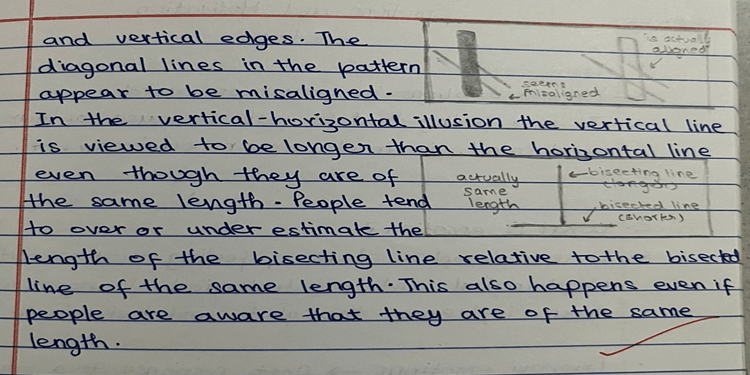
25.Write a note on illusions?


 Paawni Goyal